
Physical Therapy for a Herniated Disk in Sterling, VA

Herniated disks are one of the scariest diagnoses that you can receive when you have back pain. The idea of a disk in your back pushing on nerves is terrifying. Unfortunately, herniated disks are also one of the most misunderstood diagnoses that I see as a physical therapist. I worked in a spine clinic for several years and have probably dealt with hundreds of patients suffering from a herniated disk. If you find yourself suffering from back pain and the physician tells you that you have a herniated disk, find a physical therapist who has experience dealing with spine issues. You are going to be understandably nervous and upset, and the physical therapist’s job is to offer some perspective and a plan for you to feel better. This blog post does not replace the need for a physical therapist, but hopefully it can give you some comfort and information from someone who has worked with a lot of people suffering from herniated disks.
What is a Herniated Disk?
Part of the fear involving herniated disks is the lack of understanding about the anatomy and recovery involving the disk and surrounding nerves. The disk that becomes herniated is an intervertebral disk, meaning it sits between the vertebrae of your spine. It works to provide shock absorption and decrease stress to the bone. It also increases mobility of your spine by providing greater mobility between spinal segments. Fun fact: as you get older, your disks shrink due to loss of fluid and general aging. This is a large part of why you get shorter in later years. It also contributes to decreased spinal mobility. A positive aspect of this process is that as you get into your 40s and 50s, you are less likely to herniate a disk because there is less disk to herniate. Peak incidence of herniated disks appears in your 30s because you still have enough fluid to allow for herniation to occur, and you are probably most active.

Another important factor to understand is that some herniated disks do not cause issues at all. 37% of 20 year olds and 96% of 80 year olds had asymptomatic disk degeneration (Brinjikji, et al.). Since we have established that disks degenerate as you age, it makes sense that older populations would have a high incidence of disk degeneration. Even in younger individuals, herniated disks do not guarantee pain. Once you understand that the findings of an image do not always correlate with pain, you can take a step back from the scary MRI image your physician shows you at your appointment.
So now we understand that your imaging does not define your case. Another misconception that I encounter is the idea that surgery is required for a herniated disk. This is not the case. As the Cleveland Clinic states, “herniated disks usually heal on their own within four to 6 weeks.” Now, 4-6 weeks can feel like an eternity when you are experiencing pain in your back or down your leg, but there is no rush to get surgery. Conservative care, including physical therapy, has a tremendous success rate.
It is important to understand the actual mechanisms of a herniated disk, the downsides of imaging, and the success rate of physical therapy. Now, I want to talk about specific lifestyle interventions and exercises that I give my patients to help recover from a herniated disk.
What to Do with a Herniated Disk
The most important thing that you can do with a herniated disk is keep moving. The old ideas of “throwing your back out” and lying around in bed for days are not supported by evidence or my experience. Even light movement including walking is hugely beneficial if you are suffering from a herniated disk. Your body is creating inflammation in your low back to help with healing. Your job is to create movement and blood flow in the area so the inflammation dissipates and gets reabsorbed. Staying in one place causes your back to stiffen and become increasingly irritated. Movement is best for most injuries, but especially a herniated disk.
The typical movements that exacerbate a herniated disk are flexion (bending forward) and rotation. If your back is irritated with these movements, it is best to avoid them in the short term. Choose standing over sitting and turn your whole body rather than twisting through your back. If you are going to sit, use a rolled up towel or something behind your low back to increase your extension. This can decrease pressure on the disk. It is also best to move around throughout the day. Set an alarm for every 30 minutes and get up and walk. Prolonged sitting is going to increase inflammation and strain on the disk.
When sleeping at night, fully extended postures will work best. Sleeping on your back is typically better than your side. You might like a pillow under your knees if you sleep on your back. If you sleep on your side, a pillow between your knees can help decrease strain on your spine. Sleeping or even just lying on your stomach can be helpful to relax the muscles in your back. Put a pillow under your stomach if you need to and spend some time on your phone or watching television on your stomach. As you start to recover, you can slowly introduce more bent postures throughout the day to see how you tolerated them.
Your physical therapist should be able to advise you about your healing timeline, but you can also check for yourself. If you have a lot of pain with bending forward, avoid that movement for the time being and stay extended. As your pain decreases, you can gently bend forward more to improve mobility and decrease guarding of your muscles. Let’s talk about some exercise options including ones to get your spine moving in the right direction.
Exercises for a Herniated Disk
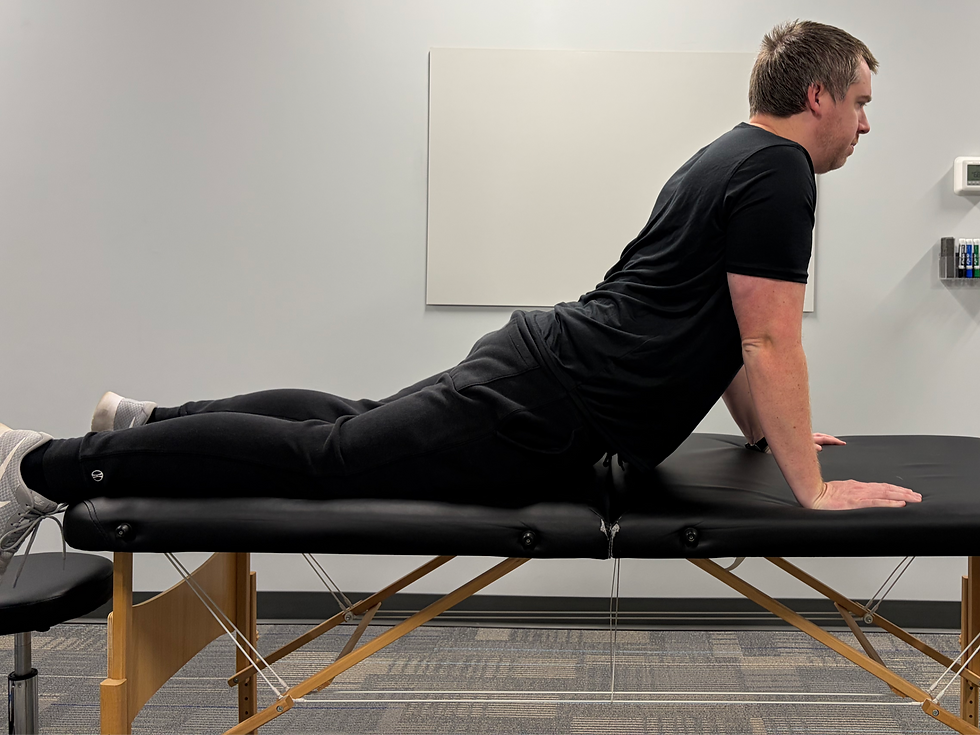
The best exercise for a herniated disk remains walking, but the next best is time spent in extension. Try a prone press up, where you lie on your stomach, place your hands at your sides, and extend your arms like you were doing a push-up. Keep your hips on the ground and stretch your back into extension. If you can only make it to your elbows that is fine. Spend some time and take some deep breaths in the end position to allow your muscles to relax. This is a great way to get your spine moving when you have a lot of pain with flexing or other movements in general.
Another movement to master during your recovery is a pelvic tilt. Many clients that I see who have acute or chronic low back pain are terrible at moving their pelvis. It is easy for your entire low back to become a stiff board that moves together and loses all mobility. This sets you up for further injury down the line when your muscles become stiff and weak together. Lie on your back with your knees bent and try to move your low back on and off the ground as far as you are able. You should picture tipping your hips forwards and backwards as much as you are able. Once this is easy, try it in sitting and eventually standing for a real challenge. This movement helps with recovering from back pain, but it also sets you up to prevent further pain in the future.

A great way to introduce rotation is with a pallof press. Isometric activation of muscles involves stimulating the muscles without actually moving them. Think of a wall sit instead of a squat. A pallof press involves using a heavy band anchored to your side. You should step out from the anchor until there is significant resistance. Keep your feet shoulder width apart and bend your knees slightly, Push the band in and out from your chest without letting your body rotate. This activates the small muscles near your spine that are responsible for rotation, but it provides minimal stress. These muscles will help stabilize your disk and provide overall stability with rotational movements. You can make a pallof press harder by stepping further from the anchor, using a heavier band, putting one foot in front of the other, or any other way you can think.

Squats are a great exercise to introduce load through the low back. They are also an easy exercise to scale. Limiting the distance you squat is the best way to decrease lumbar flexion and potential exacerbation of discogenic pain. If you are familiar with squatting, then you have probably heard the term “butt wink” which refers to lumbar flexion at the bottom of the squat. The best way to prevent lumbar movement at the bottom of the squat is to never get there. Squatting to a chair, bench, or similar object behind you can limit lumbar movement. You can gradually increase the depth of your squat to improve your low back’s tolerance to load. You can also increase the weight you are holding to further progress loading of the low back. All of the exercises that I use with my clients can be scaled to allow for progression. You do not want to become complacent with any exercises and it is always good to have avenues to progress your strength, mobility, and other qualities.

Deadlifts are the best exercise for loading the back muscles. If you want to prevent back pain from re-occurring, you should train the muscles in your back to be as strong as possible. Deadlifts allow you to load the back and hip muscles to prepare for picking up heavy objects. Once you become comfortable with deadlifts, Jefferson curls allow you to progress spinal mobility with a load. The only downside with deadlifts is that they teach rigidity through the back. We want to allow for relaxation and mobility of the individual spinal segments and muscles. Jefferson curls are a great way to improve your confidence and comfort with spinal movement.


The final movement that I utilize with clients is a variety of quicker, more powerful movements such as medicine ball throws. Lifting heavy weights is important, but you can also suffer injuries with rapid movements. It is important to train your body and especially your back to handle these rapid movements. Throwing a medicine ball as fast as possible will reveal any limitations or hesitations that you might have, and it prepares you for quickly turning to catch something in the real world.

Final Thoughts on Herniated Disks
If you are dealing with a herniated disk, it is important to try your best to relax. Find someone (ideally a physical therapist) who has experience with this condition and can guide you through the process confidently. Conservative care works, but it takes time. Patience and consistency will serve you well in recovering from a herniated disk.
If you are in the Sterling, VA area and dealing with a herniated disk, feel free to reach out through our website and set up an evaluation. This can be a difficult process, but I will help you out with each step so that you are able to recover faster and get back to doing what you love without pain. Thanks for reading!
If you would like to watch a video demonstration of the exercises discussed above, click here for our YouTube video on this topic!


Comments