
Baseball Players: Trying to Get Rid of Shoulder Pain? Move Your Scapula!

As a baseball physical therapist, I see a ton of baseball players dealing with shoulder pain. Throwing a baseball is inherently a stressful activity, and the shoulder often takes a good deal of that stress. By the time athletes come to me, they have typically seen their primary care physician, talked to a coach, or asked Google what to do. Sometimes the answer is all 3. A physician will typically tell you to rest for at least 2 weeks and then gradually ramp up, a coach will try to fix your mechanics, and Google will tell you that your arm is going to fall off. None of these are the answer, but they are still persistent in our thinking about baseball and shoulder injuries.
You probably do need relative rest. That does not mean you stop throwing for 2 weeks. In severe cases, you may need to shut down for a period of time, but this leads to increased injury risk from ramping back up to your previous throwing. You may need to tweak your mechanics, but this can be difficult because you are missing the root cause issue. Finally, you do want to be careful with any sort of pain or injury, because baseball players need their arms to be healthy.
So, what do you do if you are experiencing shoulder pain? Go see a qualified professional. Find someone who is medically trained but also understands the unique demands of baseball. That being said, I wanted to take some time to discuss something that many physical therapists often overlook: scapular mobility.
Shoulder Anatomy
The shoulder is probably the most complex joint in the body. The reason for its complexity is that it is the most mobile joint. People often describe the shoulder as a ball in a socket, but the more appropriate analogy is a golf ball on a tee. There is less joint stability in the shoulder than any other joint. We rely on our muscles to provide most of the stability in the shoulder, which allows for incredible range of motion, but also increased injury risk.
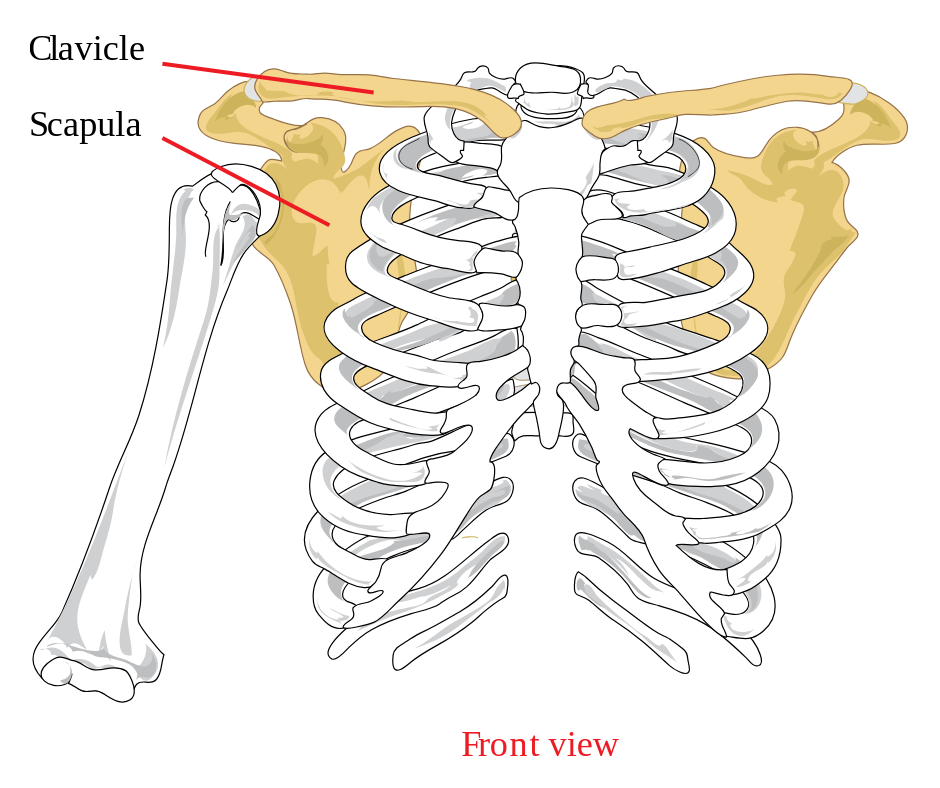
The “shoulder joint” typically refers to the glenohumeral joint, which is the connection between your humerus (the long bone in your upper arm) and the glenoid fossa, which is a divot in your scapula for the humerus. The glenoid fossa is the base for the shoulder, and it is referring to a part of your scapula. Logically, the position of the scapula is important in determining where your shoulder moves. Therefore, we should be paying more attention to the scapula, and its ability to move in different directions, when dealing with shoulder pain.
What Happens to the Shoulder While Throwing
Now let’s dive into the shoulder while you are throwing a baseball, particularly in the position of full layback. Above, you can see the shoulder is maximally externally rotated, meaning the hand is furthest behind the head. This puts tremendous pressure on the shoulder. Your rotator cuff muscles are all at the end of their length, there is tremendous force going through your arm, and you are probably fatigued from already throwing.

In the position of full layback, there is tremendous stress on the back of your rotator cuff. This can result in internal impingement, a term that refers to the rotator cuff muscles rubbing against the back of your humerus. This results in pain, decreased mobility, and difficulty with throwing. Many athletes that I see have been advised to strengthen their shoulders - usually with J bands or similar tools, but this is not fixing the underlying issue. The head of the humerus is sitting in a forward position because the glenoid fossa is rotated forward. The scapula is not retracting (moving towards your spine) enough to put the shoulder in a good position. This results in pinching in the back of your shoulder that will not improve with just using shoulder-specific exercises.
The Fix for Shoulder Pain - Move Your Scapula
The easiest way to decrease your shoulder pain is to improve the base upon which your shoulder moves. Here is a simple test that you can try. Sit with your shoulders slumped forward. Try to reach overhead and feel how tight it is. Now sit up straight and do the same thing. The position of your spine, ribs, and scapula dictates your shoulder mobility. Do the same thing trying to get into layback and you will see that the scapula definitely plays a role in shoulder pain.
The important factor that often goes overlooked by pitching coaches is the reason for limited scapular mobility. Simply stretching your shoulder may help with your scapular mobility or it might make the pain worse. Your scapula rests on your rib cage, which is controlled by your thoracic spine. A thorough evaluation including mobility of those areas will provide information regarding your individual limitations. I have seen many pitchers who get better with pec stretching, but I have seen just as many who actually need to work on thoracic mobility. The sooner you see an expert, the sooner you can target your own restrictions and address them.
Exercises for Scapular Mobility
Unfortunately, I am not able to assess you through your screen, so I will highlight some exercises and rationale that I use to hopefully give you an idea of where to start.
The first exercise is known as an open book, and it addresses thoracic and rib mobility. Lie on your side and separate your arms as far as you are able. At the end position, take some deep breaths to expand your ribs. Do this to both sides and focus on keeping your knees together to isolate thoracic movement.

Next, if the limitation is actually the front of your shoulder, your pectoralis major and minor could be involved. They attach to the front of the humerus and can limit external rotation and scapular movement. If you are going to stretch your pecs, let’s actually do it correctly. Find a doorway or wall and elevate your arm to the point where you feel a good stretch. Maintain a neutral pelvis to avoid low back extension that compromises your stretch. Take deep breaths in the end position to allow for rib mobility since the pecs attach to the rib cage

If you know anything about me, then you know I love loaded mobility. Rows are an excellent way to unlock scapular mobility when performed correctly. Allow your scapulae to rotate around your body in the extended position. When pulling the weight back to you, initiate the movement from your scapula and squeeze it as close to your spine as possible. Control the movement and maximize mobility and you have a fantastic stretch for all of the scapular muscles.

Finally, the most baseball-specific exercise is throwing. Using a weighted ball or plyo ball will allow you to feel the movement at your scapula and shoulder. If you do not get adequate scapular retraction with throwing, you will know it sooner with a heavier ball because it will create more discomfort. The heavier weight will also slow down your movements to allow for a greater stretch. Gradually return to a regular baseball and try to maintain the feel of your scapular mobility with the heavier ball.

These are just a few of the exercises that I will use with clients. As I mentioned, the best exercises are the ones tailored to your needs.
How to Improve Shoulder Pain in Baseball Players
There are many reasons for shoulder pain in baseball players. In my experience, you can improve a lot of shoulder pain by improving scapular mobility. Putting the shoulder in a more stable position can decrease pain and improve performance in the vast majority of pitchers. Hopefully this gives you some ideas on what to address with your own workout and throwing program.
If you determine that you need assistance from an expert, make sure that you know what you are looking for. You should ideally find someone who is a medical professional with training in assessing mobility, strength, and biomechanics. You also want someone who actually understands baseball and has worked with many baseball players. The baseball shoulder is unique and should be treated as such.
If you are in the Northern Virginia area, reach out for an assessment to get to the bottom of your shoulder pain. Let’s make a plan to get you back to throwing pain-free!
If you want more information on this topic or prefer video explanations of the exercises mentioned above, check out our video on scapular mobility for shoulder pain with throwing here.


Comments