
Arm Care for Baseball Coaches

It is that time of year again. Spring is right around the corner, which means baseball is almost back. That means that teams are starting to ramp up their training. Which means that batting practice is heating up. That can only mean one thing: coaches arms are starting to hurt.
As a former high school baseball coach who transitioned to coaching tee ball due to my son starting tee ball as well as not wanting to throw BP, I understand. Taking 3 months off and then jumping right into throwing 200 pitches is not ideal. If a pitcher on your team did something similar, they would lock you up. So, what is the answer? Let’s talk about arm care for an often overlooked population (baseball coaches) and some realistic options to get you through the season.
What is Arm Care?
Arm care is everything and nothing at once. Arm care can refer to some light band exercises and it can refer to heavy weightlifting to prepare for the season. Ideally, you are working out throughout the year, including the off-season. Maintaining or improving your strength and mobility during the off-season is the best way to decrease that early season soreness. However, if you just do not have the time for this, look no further than what I am going to share with you. This blog post is for the coach who kept saying they would start training after Thanksgiving, then after the holidays, and then, boom, the season is here. The best way to prevent a forest fire is prepping your site carefully, studying the weather, and practicing for every situation. The next best option is to bring a fire extinguisher to stop the small fire from becoming a big fire. Let’s talk about fire extinguishers.
What Should I Do for Arm Care?
Arm care and recovery should address three main topics: soft tissue mobility, joint mobility, and muscle activation. Soft tissue mobility refers to the need to calm the muscles down. This can be achieved with massage implements including lacrosse balls, foam rollers, massage guns, or numerous other things. I will highlight lacrosse ball and foam roller exercises because most folks have those tools. If not, they are easy to order.
Joint mobility will include some stretches and joint distraction exercises. Gentle traction on a joint can feel good and improve blood flow. Imagine someone gently pulling on your shoulder, it feels good because it helps.
Finally, muscle activation refers to the need to gently stimulate the muscles after using them. If you go for a run, you do not just sit around the next day unless you want to cramp like crazy. Throwing is no different. It creates damage to the muscles and light muscular contractions can create a pumping effect that allows the inflammation to transfer in and out of the muscles to optimize healing. Now that we have covered the mechanisms behind these three concepts, let’s get into some specific examples.
Soft Tissue Mobility for Arm Care
In general, if a muscle is sore, it will benefit from mobilization. I want to highlight a few specific muscles that can tighten, and my favorite ways to address them.
First, the wrist flexors are the muscles along the palm-side of your forearm. They flex your wrist and fingers along with crossing the elbow joint. They take a lot of strain from throwing, especially if you are flicking a ball from 30 feet away. 200 throws from 30 feet is not conducive to fully pulling your arm behind you and loading your scapula. Instead, you are probably flicking darts. This leads to increased elbow and forearm stress. Try this exercise with the lacrosse ball:

With all of these exercises, stick to 30-60 seconds. Roll the ball around and let it linger on particularly sore areas. If you are feeling sore you can try a couple of sets each day. Doing this for more than 60 seconds can lead to increased tissue damage which is counterproductive. A little goes a long way in this case.
The next muscle group that I love to target with a lacrosse ball is the pecs. If you are loading your shoulder (good for you, Mr. or Ms. Fundamentals) then your pecs are taking a lot of strain. They initiate shoulder adduction which refers to your shoulder coming across your body. Using a lacrosse ball is a fantastic way to target the muscles. Be careful to not put too much pressure on your ribs. You should be able to identify the difference between muscle soreness and rib pain. The former is good, the latter is not.

The last muscle that I want to address with the lacrosse ball is the triceps. This muscle is often overlooked, but it helps you extend your elbow. It also runs into the back of your shoulder and triceps tightness can limit overhead range of motion. I still remember treating a cricket player with shoulder pain years ago and I dry needled his triceps. He had immediate relief and improved flexibility. Ever since then, I always remember to check the triceps. Try this movement to loosen up the triceps.

These next two movements that I want to demonstrate involve using a foam roller. You can substitute a lacrosse ball, but the increased surface area of the foam roller helps target more muscle while decreasing the pinpoint pressure that can be painful in some cases. You can try using a foam roller and a lacrosse ball and see what you prefer. There’s more than one way to skin a cat and more than one way to limit your day-after-BP Tylenol consumption.
This first movement addresses the muscles of the thoracic spine. You rotate through your thoracic spine a ton when throwing, and you probably do not do that much in your daily life. This leads to stiffness throughout the day that can cause muscular pain (because your warm-up consisting of 3 light throws into the L screen does not adequately prepare your spine). Place the foam roller perpendicular to your spine and roll up and down. Give yourself a big hug to move your scapulae out of the way and expose the muscles of your spine. Take deep breaths while you roll.

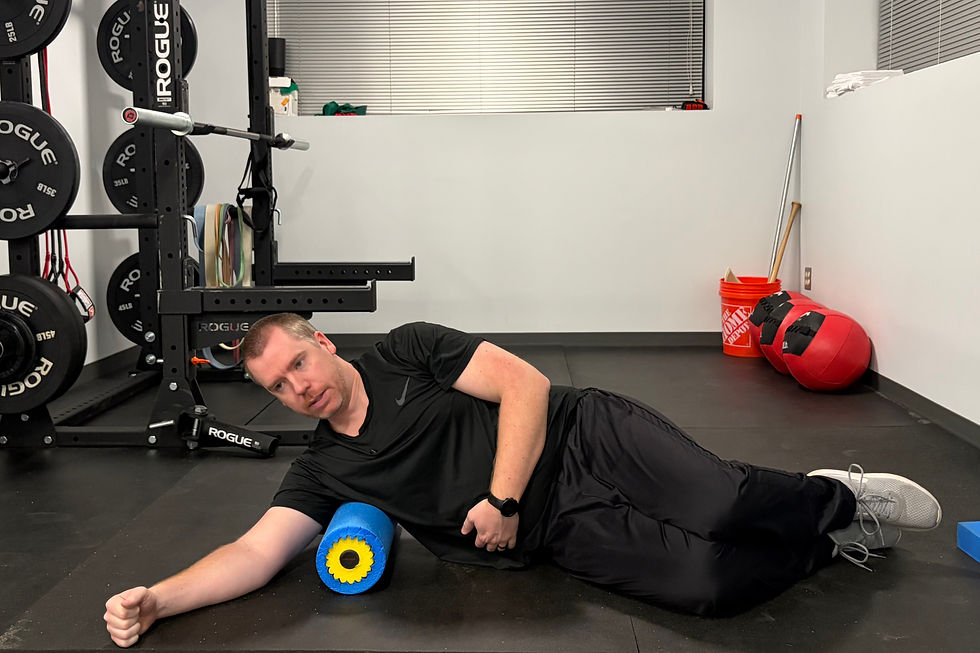
The next movement is foam rolling for your latissimus dorsi (lat). This movement also hits the teres major which can mimic lat pain and tightness. The lat helps pull your arm down and across your body. It also limits overhead mobility if it is tight. Lie on your side with the foam roller under your scapula. Keep your arm over your head to expose the muscles and roll back and forth. Once again, you need to understand the difference between muscle soreness and rib pain. Stick to the tight muscles.
Joint Mobility for Arm Care
Joint mobility is very important after throwing. Mobilization of the surrounding muscles can help decrease joint pain and stiffness, but we don’t want to neglect the shoulder, elbow, and thoracic spine. Let’s start with the shoulder. Pendulums refer to grabbing as heavy of a weight as you can handle, leaning over, and letting your arm relax. You should try and let your shoulder stretch as much as possible. Pick a heavy enough weight that you feel a stretch but not so heavy that you have to engage your muscles to prevent your arm from falling off.

If you are able to do pendulums and need more of a challenge, try hanging. You can hang sideways or straight down from a barbell or pull-up bar. This provides amazing traction for the shoulder and is good for elbow and forearm strength (I talked more about that here while discussing elbow injury prevention). Find a position where you can relax and feel a gentle stretch.
Next, I want to discuss the elbow. Repeated throwing creates trauma to the muscles around the elbow, particularly the biceps. We want to ensure that you maintain full elbow extension. Performing some biceps curls and holding at the end position to stretch the elbow is an effective way to address mobility and get a good pump. Remember, we want muscle contractions to promote healing. Using an anchor such as a bench can allow for focus on full elbow extension and stretch.

We addressed the muscles of the thoracic spine previously, now let’s discuss the joints themselves. Open books are a great way to address thoracic rotation. Start on your side with your head supported and your arms out in front of you. Separate your arms and turn your head to follow the top arm as you rotate around your body. Keep your knees together and your hips in place to stretch your thoracic spine. Take a deep breath at the end position before returning to start. Check out this handsome model showing you how it is done:

Finally, thoracic extension is important to maintain shoulder mobility. Most of us sit all day and struggle to achieve thoracic extension throughout the day. A prayer stretch addresses lat mobility and thoracic extension at the same time. Find a bench or similar structure in front of you and go on two knees. Bring your hands together as if you were praying, sink your butt down towards your heels, let your arms come back over your head, and think about pushing your chest to the ground. Take deep breaths and each time you exhale, try to let your chest sink down.

Muscle Activation for Arm Care
Now that we have mobilized the muscles and joints, let’s get those muscles activating to promote healing. Start with the forearm and wrist muscles. Wrist flexion and extension with a light weight while sitting in a chair are easy but should not be overlooked. Wrist supination and pronation can be accomplished with a stick in standing. These movements are crucial for elbow health and should be included for muscle activation and mobility.


The triceps make their triumphant return here. Overhead triceps extensions are great for muscle activation and shoulder mobility. We like efficiency and this exercise is that. Grab a weight in each hand and go straight overhead. Bend your elbows to lower the weight down before coming back to the starting position. Hold the bottom position for a good stretch. Feel free to substitute a band that is anchored to the ground or a single large dumbbell with this exercise.

If you want to engage the muscles of the shoulder, you want to engage all of them at once. The muscles of the shoulder are crucial for stability, and engaging them in a push-up position forces them to all contract at once to keep you in position. Some slow shoulder taps force each shoulder to stabilize your body weight. Feel free to incorporate some reaches or other movements to progress your stability. Here is a picture of the basic movement:

For the last exercise, I want to focus on scapular mobility. A pull apart addresses horizontal abduction or the squeezing of your shoulder blades. This movement contracts the rhomboids and other muscles in between your shoulder blades which help control the deceleration phase of throwing. It also stretches the pecs in the front of your shoulder. Do not forget to address these foundational pieces.

How Can I Implement Arm Care?
If you want to implement arm care into your routine, good for you. You will be a better coach if you are not constantly worried about your arm pain when throwing BP. You will be more present for your players and better able to focus on their performance at the plate instead of focusing on your arm. I don’t expect you to implement all of these exercises, but I encourage you to try them all. See what works for you. If your forearm is always sore after throwing, definitely include some soft tissue mobility for those muscles. Try the other movements and see what works for your body and your schedule.
The best arm care is having a plan. Ramp up your throwing throughout the season. Also, there is no shame in using machines or working in some live ABs. Your players will probably get more out of you cranking up a machine to mimic fastballs compared to you lobbing in 50 mph meatballs. This also allows you to control your workload throughout the week. Having a plan, even if it is a bad plan, is better than no plan at all.
If all else fails, go see a physical therapist. There is no shame in getting some tips and individualized strategies. I see a lot of baseball coaches who are very stubborn. Throwing hundreds of pitches in a single practice is an incredible load on your body and you need to take care of it. Seek help before you have a worse injury. If you are in the Sterling, VA area, reach out for an assessment and we can make a plan based on your body. If you want to watch video examples of the exercises discussed above, feel free to watch our YouTube video on this topic.
If you found this helpful, please share it to get the word out. We need to protect our baseball coaches from March arm injuries; there is no IL for coaches.


Comments