
Strength Training for Middle School Baseball Players

What is a Good Workout for Middle School Baseball Players?
A couple of weeks ago, I wrote about strategies that I would use if I had a middle school baseball player. Someone on social media commented that they liked the videos, but they wanted to know what an actual general strengthening workout would look like for a middle school baseball player. Honestly, it was a great question, and I probably should have answered it as part of my post a couple of weeks ago. Instead, I decided to dive deep into the foundations of strength training for middle school baseball players and write a whole blog post about it.
Before we get to specific exercises, it is important to understand the principles of general strength training. We are trying to build the best general athlete that we can, so we want to maximize our time in the weight room to provide the biggest benefit. As I previously mentioned, middle school is not the time to be doing body builder splits of push-pull-legs or anything like that. Ideally, you are lifting three times a week and targeting all of the essential movements for each workout. That way you are squatting three times a week instead 1-2 times depending on your workout splits. This allows more practice of the general movements and greater strength gain. The first couple of years of lifting are all about building muscle and strength to set you up for a lifetime of training. The only exception to this is an arm care routine. If you want a simple arm care routine with minimal equipment, we offer one that covers 6 weeks and can be repeated.
The 6 foundational movements that we want to program in each workout include: push, pull, squat, hinge, rotate, and plyometrics. Each workout should include a component of those movements, with some variability so that you don’t get bored. For each movement I will provide 3 suggestions, but there are many iterations that you can use. In general, I recommend 2-3 sets of 10 repetitions for each movement with moderate intensity. Make sure you are warming up before you exercise. You can train each exercise separately or in a circuit depending on your preference and equipment situation. Without further ado, let’s get to the workout!
Push Exercises for Middle School Baseball Players
Push exercises are the easiest to understand. We are focused on pushing the weight away from us to develop the chest, fronts of the shoulders, and triceps. The simplest push exercise is a push-up. You can scale these with chest press using dumbbells, a barbell, or a machine. Focus on keeping the core lightly engaged during push-ups to move your entire body together. You should not be feeling your upper body move and then your lower body, it should be one solid unit.

An overhead press is another important pushing movement. We want to remember to push and pull from above as well as straight ahead to develop the shoulder muscles. Overhead press is pretty easy to scale with heavier weights. Younger athletes should sit down with overhead press to minimize compensation with their legs and low back. If you have to arch your back, you have too much weight. Think about gently contracting your core muscles to stabilize in a neutral position and try to stay there throughout the movement.

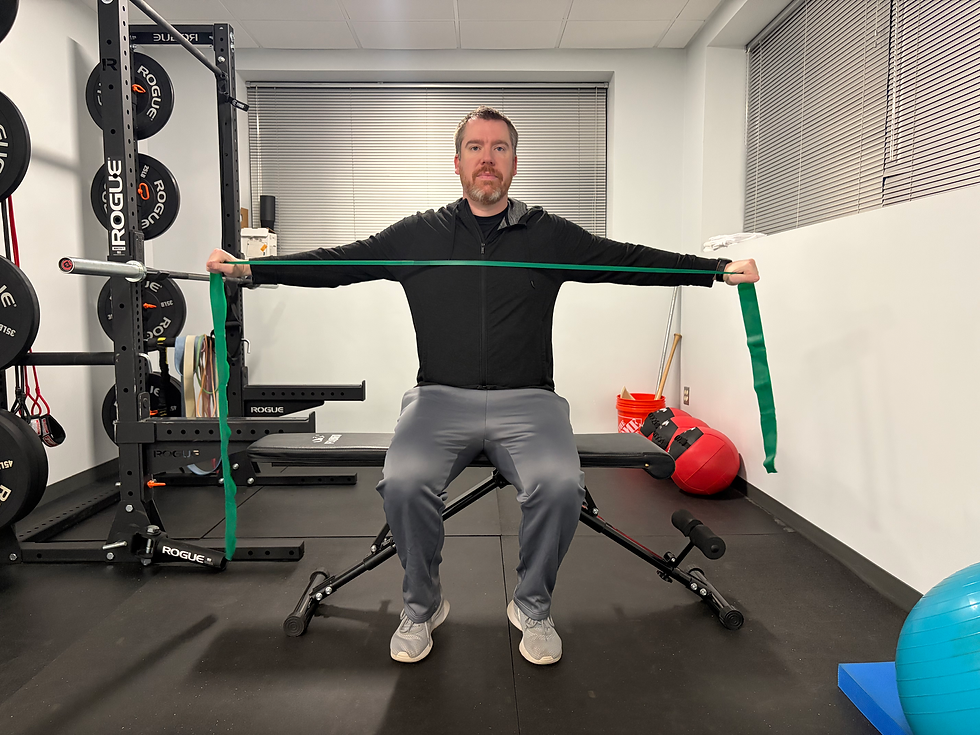
Finally, lateral raises are an often-overlooked pressing movement. These target the deltoids and shoulder muscles in a way that is frequently neglected. Shoulder development is crucial for young baseball players, and sometimes you want to mix up the pressing exercise. I would not use lateral raises extensively, but they are a good way to change up your training while focusing on arm strength. Typically you want to keep these to 90 degrees, but you can definitely go higher if you like. You can play around with hand position including going thumbs up or moving the weight in front of you to target different muscle groups.

Pull Exercises for Middle School Baseball Players
Pull exercises are geared towards developing the back, scapula, and rotator cuff muscles. We use our back muscles in baseball with swinging and throwing to accelerate and decelerate our swing and throw. Start off with a basic single arm row, emphasizing full thoracic rotation. The movement should come from your shoulder blade coming back and forward, with your arm along for the ride.

Lat pulldowns are a great way to incorporate overhead pulling which really targets the latissimus dorsi. This muscle is huge and is important for hitting and throwing. These are also effective for improving overhead shoulder mobility if you are feeling tight. A lat pulldown machine is great, but a band can suffice. Focus on pulling your elbow down by using your scapula to maximally activate the lat.

Horizontal abduction refers to the squeezing of your scapulae. Using a band can typically provide plenty of resistance for young baseball players, but a face pull movement with a pulley or a reverse fly with dumbbells or a machine also work. Avoid arching your back with this movement, as it leads to excessive lat compensation. We are here to work the rhomboids and traps between your shoulder blades, so make sure they are doing the work.
Squat Exercises for Middle School Baseball Players
Squats are one of two fundamental movement patterns for the lower body. Squats target the quadriceps in the front of your leg, but they also include the glutes, hamstrings, and calf muscles. I see a ton of young athletes who struggle with squatting, especially in the lower range. I start most of my athletes with a box squat or a squat from a chair. You can hold weight in front of you with this movement, but we want to isolate the top part of the squat and emphasize control and stability.

Once you are comfortable with squatting to a certain depth, it is time to deepen the squat. Focus on keeping your weight as evenly distributed between the front and back of your feet as possible. Do not keep all of your weight through your heels or avoid letting your knees go over your toes. Instead, relax and let your body move how it wants to. Gradually add weight as you are comfortable by holding a weight in front of you and eventually progressing to a barbell on your back if you are comfortable and want to progress.

A more challenging squat involves using one leg at a time with a lunge. This focuses on stability through each leg. It is important to understand the reason for each exercise. If you are trying to get as strong as possible, you want to be squatting and staying as stable as possible. If you want to focus on balance or addressing asymmetry between your legs (something that is common in baseball players), then you should include some lunges. Focus on dropping your weight straight down similarly to a lunge. Keep your feet close enough together that you can maintain an upright posture without overly extending your back.

Hinge Exercises for Middle School Baseball Players
Hinges are the equivalent of squats for the back of your legs. They target the glutes and hamstrings. The simplest introduction to a hinge is a bridge. You should feel fatigue through your hamstrings and possibly glutes with bridges. If they are not difficult you can hold them for longer, go on one foot, put your foot on an unstable surface, or put weight on your hips. These are simple exercises but they teach you to hinge and begin accepting load through the back of your legs. Hamstrings cramps are normal and mean that you need to keep doing these to strengthen those muscles!

Deadlifts are the most common hinging exercise, but a lot of people struggle with the full range of motion with the movement, similar to squatting. Start with a Romanian Deadlift, which involves holding a weight in your hands, slightly bending your knees, and lowering down without bending your knees more. This trains your body to hinge and you should be thinking about moving your hips back instead of down to maximize the hinge. Go down until your hamstrings are too tight and come back up. Learning deadlifts from the top down is much more effective than starting from the bottom of the movement in my experience.

Finally, you are ready for the full deadlift. Lifting from the ground teaches you to synchronize hip and knee movements, which translates into athletic performance on the field. Keep the Romanian Deadlift in mind to ensure that your primary movement is a hip hinge, rather than a squat. Slowly progress weight and keep thinking about loading your glutes and hips rather than your low back.

Rotational Exercises for Middle School Baseball Players
Baseball players need to rotate throughout throwing and hitting, so it is important to train in the gym. I like to start people off with some basic mobility and strengthening exercises to own the rotational movement. You spend a ton of time rotating quickly on the field, so you might want to include some slower rotations in training to balance it out. Start in a side plank position with your knees bent and on the ground. Reach your top hand around the front of your body to promote thoracic rotation and core strength. As you get stronger, you can go to a full plank position and rotate even further. It is beneficial to sneak some mobility work into your lifting, and this is a great way to do so.

Building off of the slower rotations, we want to use a band to build rotational strength. The heavier the band, the greater the muscle recruitment but the slower the movement. There is benefit to training throughout a range of weight and speeds (as I discussed here), so this can be a good way to tweak that day-to-day. Some days you can focus on greater resistance and slower movements, while other days you go a little faster.

Our final rotational exercise is increasing your speed to improve performance on the field. Medicine ball throws are a great way to rotate quickly without stress on your arm. Play around with different throws, but make sure that you are throwing from both sides to balance out your repeated rotation in one direction on the field.

Plyometric Exercises for Middle School Baseball Players
The final movement that I want to discuss is plyometrics. We often neglect the role of explosive movements in the weight room. I discussed upper body plyometrics here, but I want to focus on the lower body here. The simplest plyometric to implement is sprinting. Stick to shorter sprints and work on quick acceleration. You don’t need to be sprinting beyond 90 feet if you are working on plyometrics. I love using curved sprints to add some variability and challenge your body.

Light plyometrics for the low body include pogo hops which are jumps that focus on quick movement rather than distance. You want to land and jump again as soon as possible. You can isolate the ankles by hopping as if you were jumping rope, or you can include the knees and hips. The key is to jump quickly and stick to around 10 repetitions so you don’t fatigue and start moving slower. We are training our body to move fast, so we want to train fast.

Finally, we can focus on deeper joint movements. We are taking the hops we previously performed and slowing them down to emphasize higher jumps and deeper bends. Squat lower to jump higher, but still focus on relatively quick movement. These are not plyometrics in the truest sense, but they improve joint health and tendon strength, which are important for baseball players. You can also try broad jumps or side to side jumps instead of just jumping in the air.

Workout Advice for Middle School Baseball Players
In summary, you should be sticking to the basics and maintain consistency in middle school when it comes to lifting. You will have plenty of time to experiment with other workout strategies as you get older, but that will be easier if you already have that foundation. You are more likely to stick to 3 workouts a week compared to 6, so be realistic in your goal setting. If athletes are becoming bored, I would recommend adding in one accessory exercise at the end. Throw some biceps curls or flys into the program and some athletes feel better.
At the end of the day, you want a program that is customized to your needs. Get assessed by a professional and let them help you craft a program. You do not need to be working with a trainer each day, but it may help to speak to one or a physical therapist to make a long-term plan. If you are in the Sterling, Virginia area, please reach out to get an assessment at Eclipse Wellness. If you have any questions, please email me at danny@eclipsewellnessnova.com.
If you want to watch more on this topic, check out our YouTube video here.


Comments